Making insulin delivery clearer and safer

Making insulin delivery clearer and safer

Making insulin delivery clearer and safer

Product

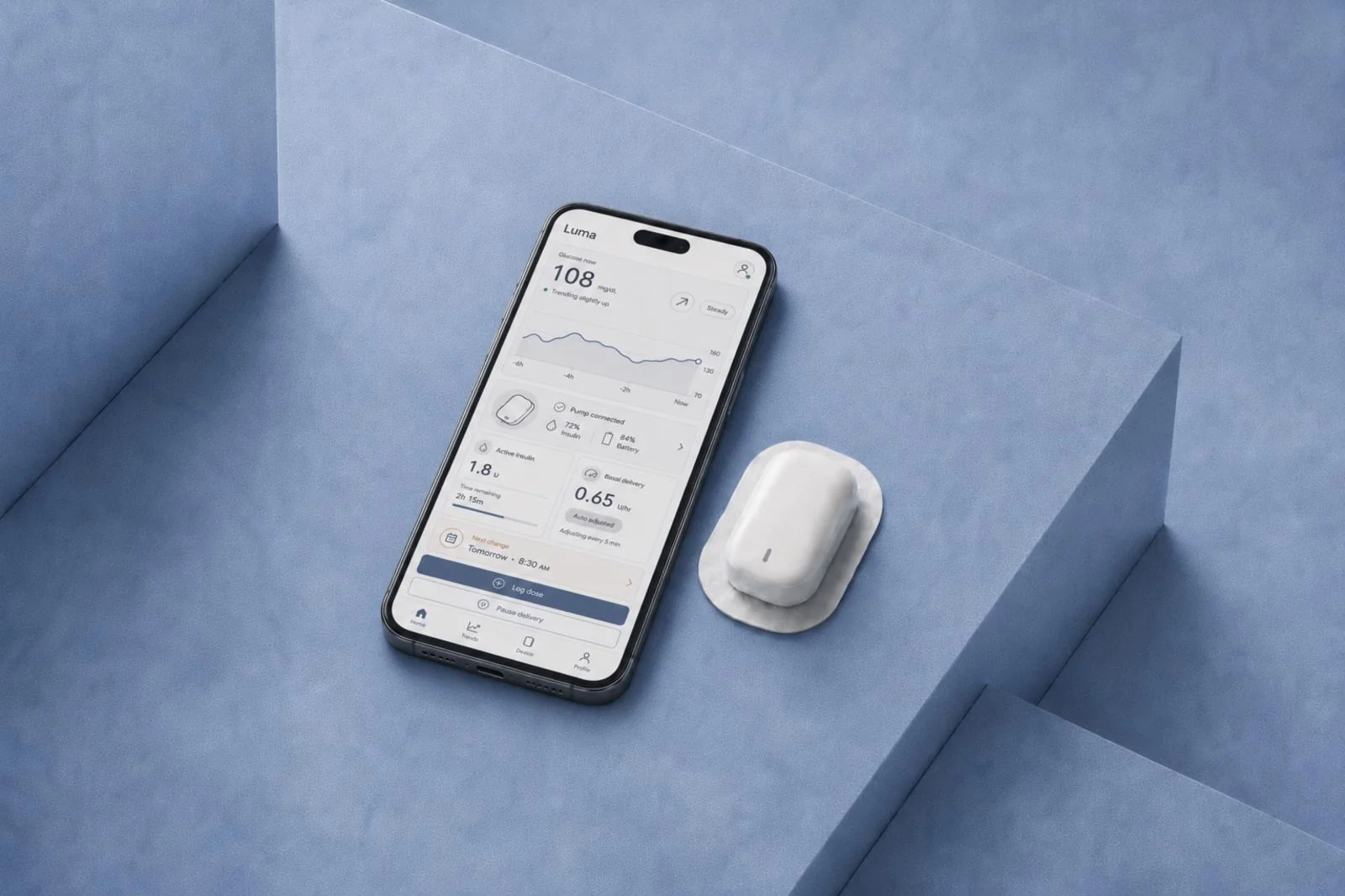
Insulin patch-pump controller

Mobile software for managing continuous insulin delivery.

Role

Lead UX Researcher & Product Designer

Led research, interaction design, formative testing and delivery documentation for the new controller.

Timeline

2 years · Startup to global medtech

15 months on the new controller for FDA submission, followed by 7–8 months contributing to established insulin-pump products after the acquisition.

scope

Research · interaction design · usability testing · design system · documentation

team

Human factors · product · engineering · QA · risk · testing

Problem Making treatment workflows safer to use

Problem Making treatment workflows safer to use

The controller supported insulin delivery, dose entry, alarms, pump replacement and recovery. A confusing interaction could contribute to a use error and potentially affect patient safety.

The controller supported insulin delivery, dose entry, alarms, pump replacement and recovery. A confusing interaction could contribute to a use error and potentially affect patient safety.

Approach Designing around foreseeable use errors

Approach Designing around foreseeable use errors

I combined domain research, workflow mapping and scenario-based usability testing to understand how people interpreted the system and where important tasks could break down. I translated the evidence into clearer flows, safer interaction rules, error states, alerts and detailed documentation for design, engineering and testing.

I combined domain research, workflow mapping and scenario-based usability testing to understand how people interpreted the system and where important tasks could break down. I translated the evidence into clearer flows, safer interaction rules, error states, alerts and detailed documentation for design, engineering and testing.

Outcome Safety risks identified before release

Outcome Safety risks identified before release

The work identified foreseeable use errors early, informed changes to critical workflows and gave design, engineering and testing one shared implementation reference. The controller later progressed into further user and clinical studies and received positive feedback from the target audience.

The work identified foreseeable use errors early, informed changes to critical workflows and gave design, engineering and testing one shared implementation reference. The controller later progressed into further user and clinical studies and received positive feedback from the target audience.

01 understand

01 understand

What did we need to learn first?

What did we need to learn first?

What did we need to learn first?

Clinical and technical evidence defined what the controller had to do, but it did not explain how people fitted insulin management into daily life. I reviewed the existing evidence and competitor products, then interviewed four experienced pump users before defining the information architecture.

Clinical and technical evidence defined what the controller had to do, but it did not explain how people fitted insulin management into daily life. I reviewed the existing evidence and competitor products, then interviewed four experienced pump users before defining the information architecture.

02 Test

02 Test

Where could foreseeable use errors occur?

Where could foreseeable use errors occur?

Where could foreseeable use errors occur?

The controller was being developed within an IEC 62366-informed human-factors process for FDA submission. Before formal validation, we needed evidence that representative users could complete critical setup and treatment tasks safely and understand where the design still required improvement.

The controller was being developed within an IEC 62366-informed human-factors process for FDA submission. Before formal validation, we needed evidence that representative users could complete critical setup and treatment tasks safely and understand where the design still required improvement.

03 deliver

03 deliver

How I carried the evidence into delivery

How I carried the evidence into delivery

How I carried the evidence into delivery

I translated the research findings into detailed workflows, interface states, terminology and reusable UI patterns. These became shared references for design, engineering and testing, and the UI Design Document formed part of the Design History File.

I translated the research findings into detailed workflows, interface states, terminology and reusable UI patterns. These became shared references for design, engineering and testing, and the UI Design Document formed part of the Design History File.

04 outcome

04 outcome

What changed because of the research?

What changed because of the research?

What changed because of the research?

For the new controller, the most meaningful evidence of progress was not conversion or retention. It was whether testing exposed foreseeable use errors, whether those findings changed the design, and whether the resulting behaviour could be implemented, tested and reviewed as part of the FDA-submission programme.

For the new controller, the most meaningful evidence of progress was not conversion or retention. It was whether testing exposed foreseeable use errors, whether those findings changed the design, and whether the resulting behaviour could be implemented, tested and reviewed as part of the FDA-submission programme.

Research question

What information and functions do experienced pump users depend on during everyday insulin management?

Research question

What information and functions do experienced pump users depend on during everyday insulin management?

Research question

What information and functions do experienced pump users depend on during everyday insulin management?

Research question

Research question

Where could users skip a required step, misunderstand the system or take an unintended action?

Where could users skip a required step, misunderstand the system or take an unintended action?

The first information architecture translated treatment routines and requirements into one shared system model.

The first information architecture translated treatment routines and requirements into one shared system model.

The first information architecture translated treatment routines and requirements into one shared system model.

3

testing rounds

8

participants

2/8

failed pump attachment

1/8

failed to suspend

3

testing rounds

8

participants

2/8

failed pump attachment

1/8

failed to suspend

3

testing rounds

8

participants

2/8

failed pump attachment

1/8

failed to suspend

Feature-by-feature plan

Expectation alignment → design draft → team review → client review

Feature-by-feature plan

Expectation alignment → design draft → team review → client review

Feature-by-feature plan

Expectation alignment → design draft → team review → client review

Why scenario-based testing? Participants completed realistic setup and treatment scenarios using the prototype. This allowed us to observe behaviour rather than rely on opinions or self-report and to improve the design before formal human-factors validation.

Why scenario-based testing? Participants completed realistic setup and treatment scenarios using the prototype. This allowed us to observe behaviour rather than rely on opinions or self-report and to improve the design before formal human-factors validation.

Scenarios covered: initial setup, basal-profile editing, bolus delivery, suspension and pump switching.

Scenarios covered: initial setup, basal-profile editing, bolus delivery, suspension and pump switching.

How we analysed the sessions

Each task was classified as success, success with difficulty or failure. We documented what happened, investigated the likely cause and considered the potential consequence and whether the interface supported recovery.

How we analysed the sessions

Each task was classified as success, success with difficulty or failure. We documented what happened, investigated the likely cause and considered the potential consequence and whether the interface supported recovery.

How we analysed the sessions

Each task was classified as success, success with difficulty or failure. We documented what happened, investigated the likely cause and considered the potential consequence and whether the interface supported recovery.

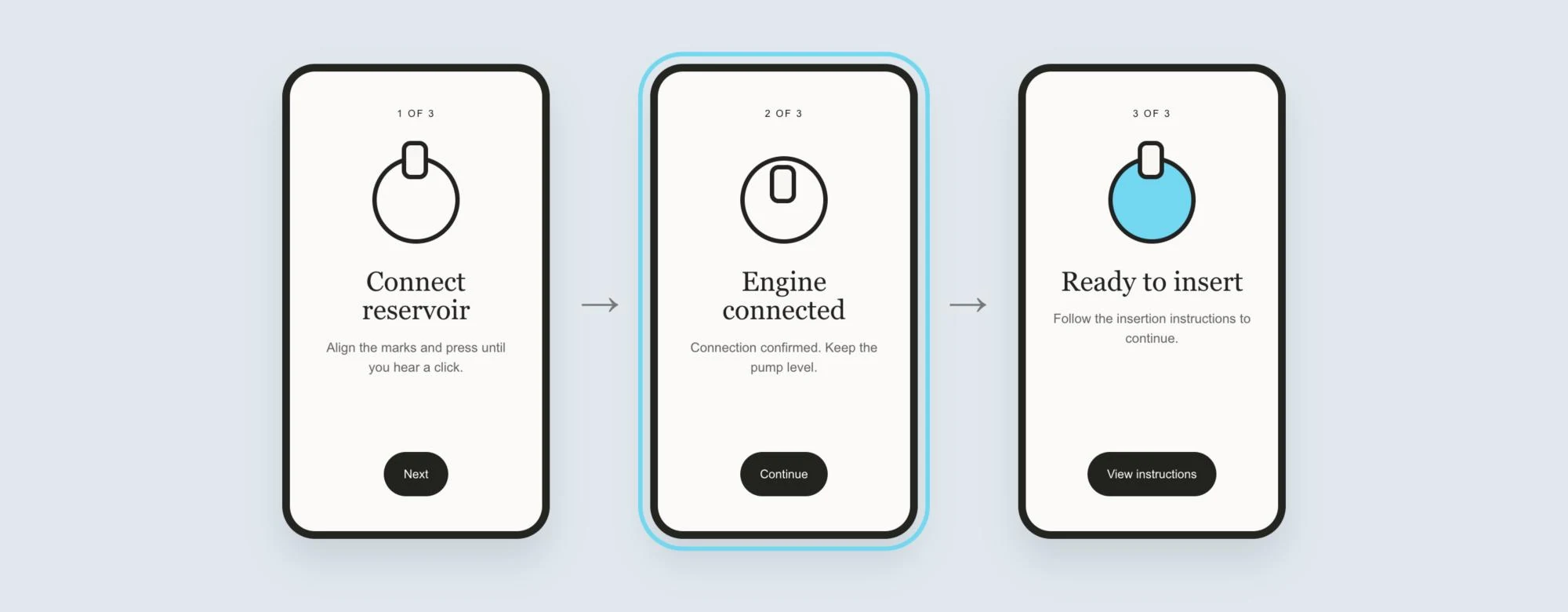
Finding 01 · Pump attachment

Finding 01 · Pump attachment

Users did not reliably follow the activation sequence

Users did not reliably follow the activation sequence

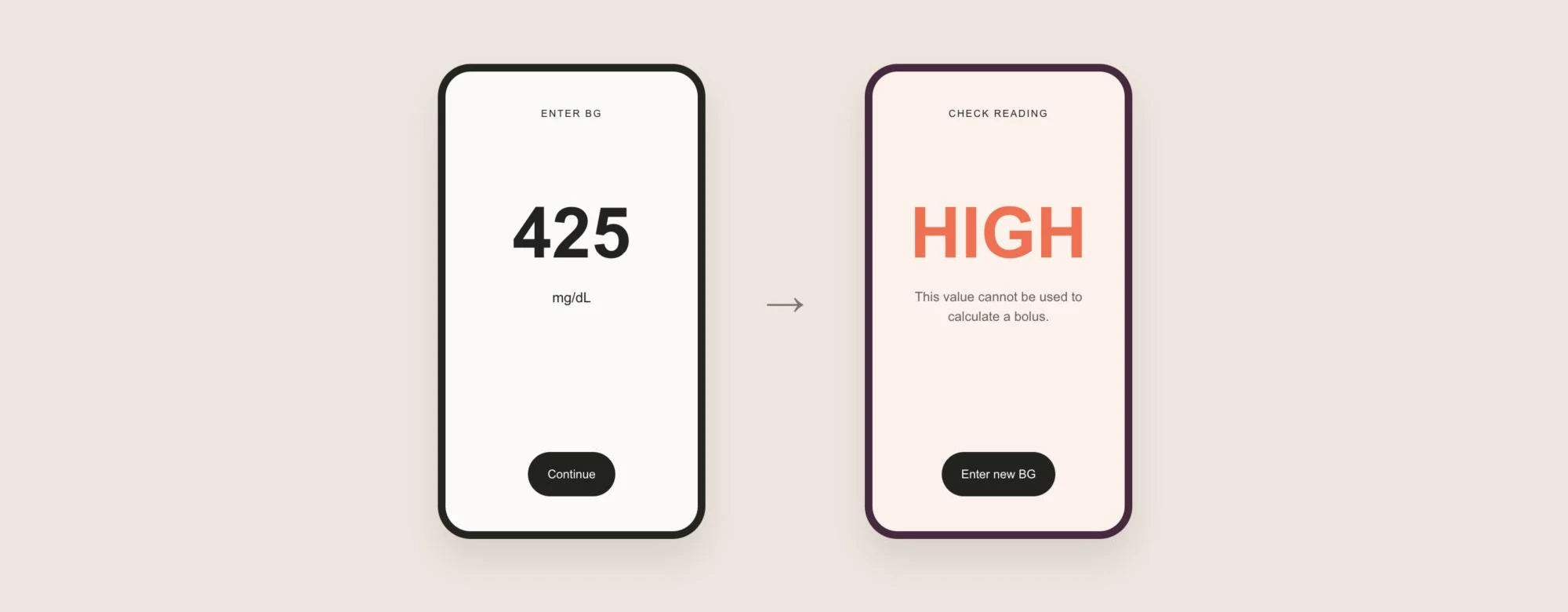
Finding 02 · Treatment safety

Finding 02 · Treatment safety

Unsupported BG values could not continue into dose calculation

Unsupported BG values could not continue into dose calculation

What happened

What happened

Two of eight participants failed; two more completed the task only with difficulty.

Two of eight participants failed; two more completed the task only with difficulty.

Why it happened

Why it happened

The current pump state and required next action were not explicit enough.

The current pump state and required next action were not explicit enough.

Interpretation

Interpretation

We revised the sequence, instructions and feedback so the safest next action was clearer and missed steps were less likely.

We revised the sequence, instructions and feedback so the safest next action was clearer and missed steps were less likely.

The trade-off

The trade-off

Adding more guidance increased the amount of information on screen, but testing showed that explicit device-state feedback was more important than visual minimalism in this workflow.

Adding more guidance increased the amount of information on screen, but testing showed that explicit device-state feedback was more important than visual minimalism in this workflow.

risk

risk

An out-of-range reading could be unreliable or require immediate attention.

An out-of-range reading could be unreliable or require immediate attention.

What we decided

What we decided

Label it HIGH or LOW, keep it out of the bolus calculation and require a supported reading before continuing.

Label it HIGH or LOW, keep it out of the bolus calculation and require a supported reading before continuing.

Why it mattered

Why it mattered

This prevented uncertain information from being used to calculate insulin and clearly showed the user what to do next.

This prevented uncertain information from being used to calculate insulin and clearly showed the user what to do next.

The trade-off

The trade-off

The user had to stop and enter a supported reading before continuing. This added an extra step, but it was safer than calculating a dose from uncertain information.

The user had to stop and enter a supported reading before continuing. This added an extra step, but it was safer than calculating a dose from uncertain information.

Enter BG flow

Enter BG flow

Enter BG flow

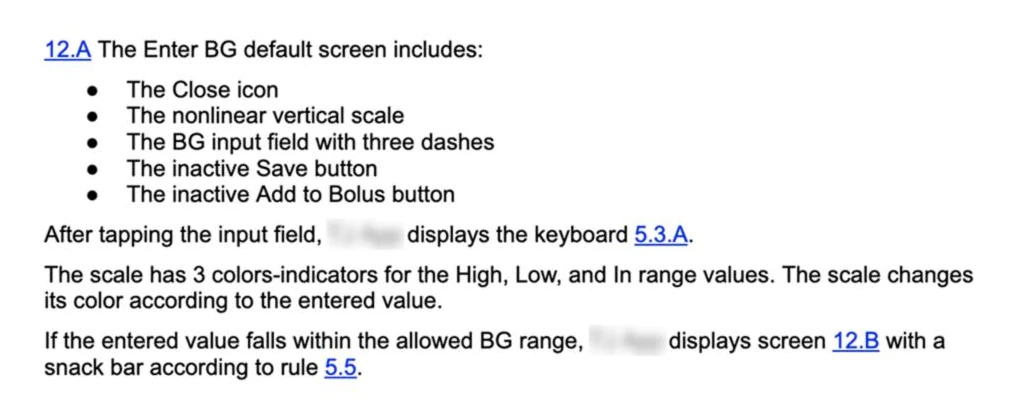
UI Design Document

UI Design Document

UI Design Document

Critical semantic tokens applied to a reusable alert pattern.

Critical semantic tokens applied to a reusable alert pattern.

Critical semantic tokens applied to a reusable alert pattern.

Patient-safety impact

Testing identified use errors, unclear terminology and problems in critical workflows early enough for the team to improve the design.

Patient-safety impact

Testing identified use errors, unclear terminology and problems in critical workflows early enough for the team to improve the design.

Patient-safety impact

Testing identified use errors, unclear terminology and problems in critical workflows early enough for the team to improve the design.

Product impact

The controller progressed into further user and clinical studies and received positive feedback from the target audience.

Delivery impact

The interaction model, design system and UI Design Document gave design, engineering and testing one shared reference for implementation.

Next case →

← All work

← All work

Interface strings unified, versioned and prepared for engineering.

Interface strings unified, versioned and prepared for engineering.

Interface strings unified, versioned and prepared for engineering.

What do you check first after waking up?

What do you check first after waking up?

Measure BG and calibrate the sensor

Measure BG and calibrate the sensor

How often do you check your blood glucose?

How often do you check your blood glucose?

2–10 times per day

2–10 times per day

Which bolus types do you actually use?

Which bolus types do you actually use?

60% quick · 30% dual · 10% long

60% quick · 30% dual · 10% long

How the project progressed

How the project progressed

Existing clinical and product evidence → domain learning and competitive research → user interviews → information architecture and wireframes → formative usability testing → iterative UI design → further testing → implementation documentation and multidisciplinary review.

Existing clinical and product evidence → domain learning and competitive research → user interviews → information architecture and wireframes → formative usability testing → iterative UI design → further testing → implementation documentation and multidisciplinary review.

4

discovery interviews

3

formative test rounds

8

participants in the reported round

3

clear delivery outcomes

Why this approach? Existing evidence defined the clinical and technical boundaries. Competitor research revealed familiar patterns and unresolved problems. Interviews added users’ routines, priorities and language.

Why this approach? Existing evidence defined the clinical and technical boundaries. Competitor research revealed familiar patterns and unresolved problems. Interviews added users’ routines, priorities and language.

What the interviews helped us understand

What the interviews helped us understand

The interviews showed what people checked first, which actions they used most often, what they expected to find in treatment history and which terms already felt familiar.

The interviews showed what people checked first, which actions they used most often, what they expected to find in treatment history and which terms already felt familiar.

How the findings shaped the product

How the findings shaped the product

I used these findings to shape the information architecture, navigation priorities and the scenarios used in formative testing. The proposed structure was then reviewed with the wider team.

I used these findings to shape the information architecture, navigation priorities and the scenarios used in formative testing. The proposed structure was then reviewed with the wider team.

What I personally owned

What I personally owned

Planned and conducted discovery interviews

Facilitated multidisciplinary workshops to align the team

Turned findings into architecture, scenarios and prototypes

Planned and conducted discovery interviews

Facilitated multidisciplinary workshops to align the team

Turned findings into architecture, scenarios and prototypes

Ran formative usability testing and analysed failures, difficulties and likely use errors

Revised workflows and interaction behaviour

Led UI delivery, interface strings, design-system work and documentation

Ran formative usability testing and analysed failures, difficulties and likely use errors

Revised workflows and interaction behaviour

Led UI delivery, interface strings, design-system work and documentation

Testing results

Testing results

Testing results

Client name withheld. The shipped interface remains confidential; selected wireframes, research evidence and system artefacts are shown instead.

Client name withheld. The shipped interface remains confidential; selected wireframes, research evidence and system artefacts are shown instead.

What changed in my practice

What changed in my practice

This was my first medical-device project, and at the beginning I found it difficult. I had to understand the clinical side, the hardware, the software and the safety process at the same time. It taught me to think beyond whether someone could complete a task. I started paying more attention to uncertainty, stress and what could happen when something went wrong.

This was my first medical-device project, and at the beginning I found it difficult. I had to understand the clinical side, the hardware, the software and the safety process at the same time. It taught me to think beyond whether someone could complete a task. I started paying more attention to uncertainty, stress and what could happen when something went wrong.

What stayed with me

What stayed with me

Speaking with people living with Type 1 diabetes made the effect of small interaction decisions feel real. The controller was only one part of their daily treatment, but it could either add to that burden or make it a little easier. With more time, I would have involved a broader mix of users earlier, including less experienced users, older adults and parents managing treatment for children.

Speaking with people living with Type 1 diabetes made the effect of small interaction decisions feel real. The controller was only one part of their daily treatment, but it could either add to that burden or make it a little easier. With more time, I would have involved a broader mix of users earlier, including less experienced users, older adults and parents managing treatment for children.